logo
Au sujet de nous
China Shenzhen Juyi Science And Trade Co., Ltd.
Shenzhen Juyi Science And Trade Co., Ltd.
Shenzhen Juyi Science And Trade Co., Ltd. est une nouvelle entreprise d'énergie engagée dans la recherche et le développement de panneaux de protection de batteries au lithium.
vue davantage
demandez un devis
01
Une qualité élevée
Le sceau de confiance, la vérification du crédit, le RoSH et l'évaluation de la capacité des fournisseurs. La société dispose d'un système de contrôle de qualité strict et d'un laboratoire de test professionnel.
02
Développement
Équipe de conception professionnelle interne et atelier de machines avancées.Nous pouvons coopérer pour développer les produits dont vous avez besoin.
03
Produits manufacturés
Machines automatiques avancées, système de contrôle strictement des processus.Nous pouvons fabriquer tous les terminaux électriques au-delà de votre demande.
04
100% SERVICE
Petits conditionnements en vrac et personnalisés, FOB, CIF, DDU et DDP.Laissez-nous vous aider à trouver la meilleure solution à toutes vos préoccupations.
Je ne sais pas.
news_bg

dernières nouvelles

Dernières nouvelles de l'entreprise sur High Current BMS for Car and Electric Vehicle Start
2026-10-31

High Current BMS for Car and Electric Vehicle Start

A protection board for an automotive starter battery acts as a "safety guardian" within an emergency jump-starter power supply. Its primary role is to prevent overcharging, over-discharging, short-circuiting, and reverse-polarity connections, ensuring the safety of both the device and the vehicle during high-current engine cranking. If you are purchasing a protection board separately—whether for assembly or repair—it is crucial to verify that the number of series-connected cells, current specifications, and battery type are all compatible.   What is an Automotive Starter Protection Board? As the name suggests, an automotive starter protection board is a safety device installed within a vehicle’s starting system. Typically located near the starter motor or the battery, it is designed to prevent damage to the vehicle’s electrical circuits and critical components caused by the sudden current surge that occurs during engine cranking. When starting the engine, a massive amount of current is required to drive the starter motor; this process can trigger transient voltage fluctuations or current overloads—issues that the protection board is specifically engineered to address.     Core Functions of a Starter Protection Board 1. Preventing Current Overload At the moment of ignition, the starter motor demands a high surge of current to crank the engine. Without a protection board, this intense current could overwhelm the vehicle’s electrical system, potentially blowing fuses or damaging electrical components. By monitoring current flow, the protection board can automatically cut the circuit during an overload, preventing further damage to the vehicle. 2. Stabilizing Voltage Fluctuations During the cranking process, the battery voltage may experience a brief drop. Such fluctuations can not only interfere with the proper operation of the starter motor but also negatively affect the vehicle’s electronic systems (such as the ECU or audio system). The protection board effectively stabilizes the voltage, ensuring the electrical system remains stable throughout the starting process. 3. Extending Battery Lifespan The high current demand during engine starting can take a toll on a battery’s longevity. By providing protection, the board alleviates the strain placed on the battery during ignition, thereby extending its service life and reducing the frequency of replacements and the need for repairs. 4. Temperature Protection and Cell Balancing Advanced protection boards may also monitor temperature—triggering a heating function in cold conditions—or utilize cell-balancing features to ensure that the voltage across individual battery cells remains uniform, further extending the battery's overall lifespan.   Applicable Scenarios for Starting Protection Boards 1. Older Vehicles For vehicles that have been in use for a long time, the performance of the electrical system and the battery may have degraded. A starting protection board can help prevent malfunctions caused by aging circuitry during the vehicle-starting process. 2. Driving Conditions Involving Frequent Starts In scenarios where a vehicle is started frequently—such as during short-distance urban commuting—a starting protection board can effectively mitigate the repetitive stress placed on the electrical system during each start, thereby reducing the failure rate. 3. High-Performance Modified Vehicles Some high-performance modified vehicles may have increased current demands during startup. A starting protection board provides additional protection for these vehicles, ensuring that the modified electrical system operates stably.     Selecting and Installing a Starting Protection Board 1. Choosing the Right Protection Board for Your Vehicle Check the battery type and the number of cells in series: Common options are designed for ternary lithium or lithium iron phosphate (LiFePO4) batteries. Ensure the number of cells in series matches your battery pack (e.g., 4S, 8S, 10S, etc.); an incorrect match will result in the board failing to function or failing to provide protection. Consider continuous and peak current ratings: For small passenger cars with lower starting current requirements, a protection board with a continuous current rating of around 100A and a peak current rating of 1000A is generally suitable. For larger vehicles or diesel-powered vehicles, which require higher current, opt for models with a continuous current rating of 150A–200A and a peak current rating of 1500A–2000A. Verify that the protection features are comprehensive: The board should at least include protection against overcharging, over-discharging, overcurrent, short circuits, and reverse polarity. Ideally, it should also feature temperature monitoring and a waterproof design.   2. Installation Considerations The installation of a starting protection board should generally be performed by a professional to ensure it is correctly integrated into the vehicle's electrical system. Improper installation can prevent the board from functioning correctly and may even lead to new issues.   Maintenance and Inspection of Starting Protection Boards Although starting protection boards typically have a long service life, regular checks of their operational status remain essential. Vehicle owners can assess whether the board is functioning properly by observing the vehicle's startup performance or by using professional diagnostic tools. If any irregularities occur during startup—such as difficulty starting the engine or significant voltage fluctuations—the system should be inspected and serviced promptly. Although the vehicle starting protection board may seem like an inconspicuous little component, it plays a vital role in a vehicle's safety and reliability. From preventing current overloads and stabilizing voltage fluctuations to extending battery life, this protection board provides an extra layer of security for your vehicle every time you start the engine. For any car owner who prioritizes vehicle maintenance, equipping their vehicle with a suitable starting protection board is not just a way to care for their car—it is also an essential safeguard for driving safety.     Advantage of Enerkey bms for Automotive/Electric Vehicle Starting 1. It can be used for All full lithium battery type, Included Ternary lithium, lithium iron phosphate, lithium titanate, sodium-ion 2. Support battery strings for 3s to 10s. 3. Continuous operating current has 40A, 80A, 120A, 200A Option. 4. Peak starting current has 80A,120A, 160A, 200A, 300A, 450A, 600A Option. 5. Individual cell voltage measurement resolution: 1Mv 6. It has temperature protection and balancing functions, effectively extending battery lifespan. 7. Includes Low-Voltage Switch, It can save more power. 8. Double-sided power MOSFET mounting with a heat-dissipating enclosure, Can be used for high temperature environment. 9. High quality materials for Automotive-grade MOSFETs and Thick-copper PCB 10. Current shunting via thickened copper strips, Low consumption11. Professional develop team, Support customized size and parameters and communication port and others as your requirement.  
Vue davantage 
Dernières nouvelles de l'entreprise sur Enerkey Nouvelle conception d'un égaliseur intelligent bi-directionnel actif à batterie CC-CC
2025-12-18

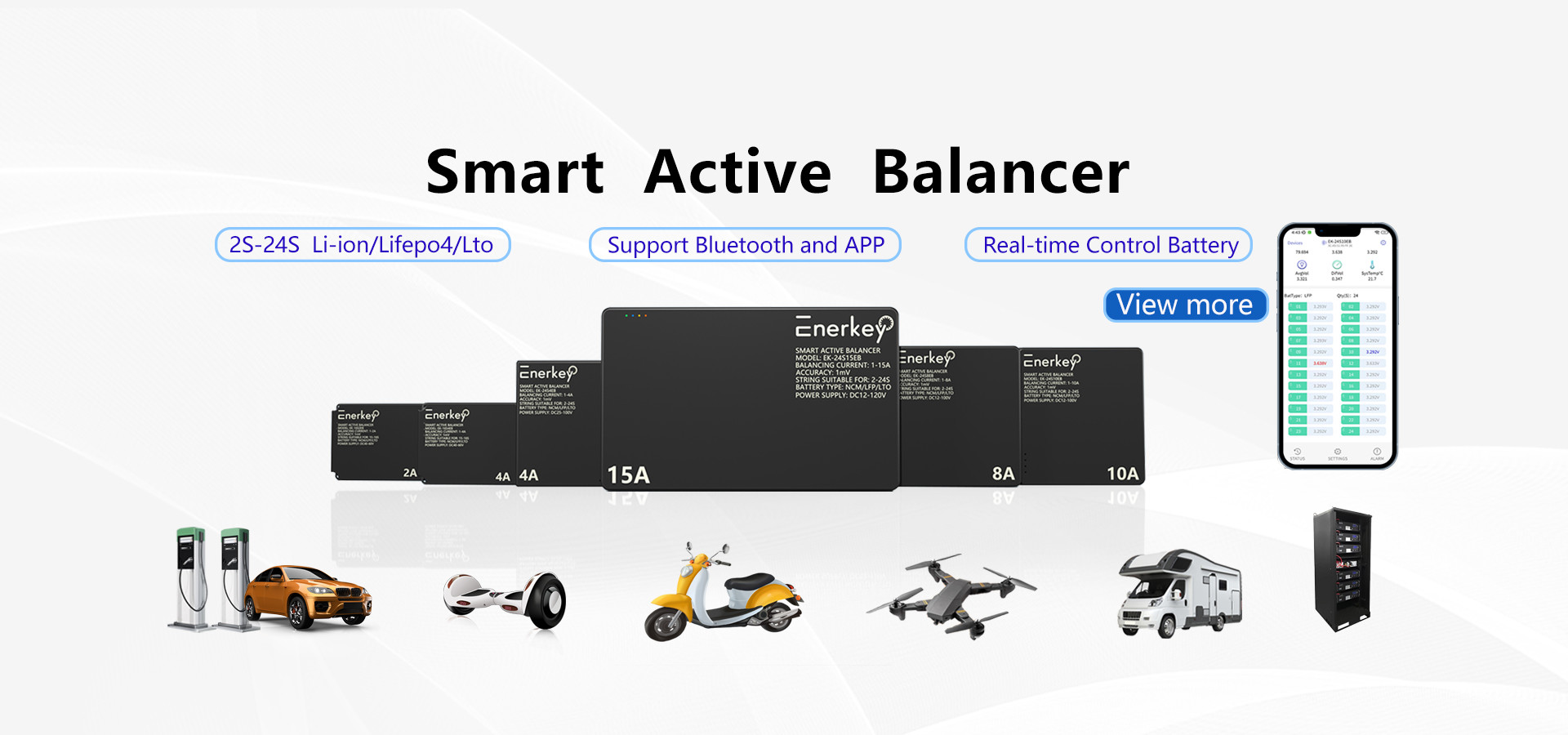
Enerkey Nouvelle conception d'un égaliseur intelligent bi-directionnel actif à batterie CC-CC

La pollution de l'environnement et les crises énergétiques deviennent progressivement les deux principaux défis du XXIe siècle.avec leurs caractéristiques d'économie d'énergie et d'environnementLes batteries, en tant que composant essentiel des véhicules électriques, sont devenues un élément essentiel de l'industrie automobile.déterminer la possibilité de développement ultérieurEn raison de limitations technologiques, la batterie d'alimentation d'un véhicule électrique est composée de plusieurs cellules uniques connectées en série.L'incohérence des performances des cellules individuelles et les surcharges et surdécharges sévères pendant l'utilisation affectent de manière significative la durée de vie de la batterie.   Par conséquent, la technologie d'équilibrage des batteries est cruciale pour le développement industriel des véhicules électriques.L'application de la technologie d'équilibrage de la batterie aux bornes de recharge pour assurer une recharge sûre et efficace de la batterie à chaque fois est un moyen de résoudre le problème de la dégradation de la durée de vie de la batterie.Les dernières données nationales et internationales montrent que la technologie d'équilibrage non dissipatif est actuellement au centre de la recherche,présentant une structure de circuit diversifiée et diverses méthodes de contrôleCependant, de nombreuses méthodes d'équilibrage restent à l'étape de la recherche théorique et ne prennent pas pleinement en compte les changements de paramètres dans l'environnement de travail réel de la batterie.Certaines stratégies de contrôle de l'équilibrage proposées sont souvent trop complexes pour être appliquées dans la pratique.     Sur la base d'une analyse approfondie des recherches nationales et internationales sur la technologie d'équilibrage des batteries, Enerkey BMS has developed an active bidirectional DC-DC battery equalizer design method specifically for the incomplete charging and overcharging situations that often occur during electric vehicle chargingCette méthode permet de charger complètement les batteries au lithium et d'équilibrer la charge d'une batterie composée de 24 cellules au lithium.Le système d'équilibrage de la batterie conçu se compose de deux partiesLe circuit principal d'équilibrage et le contrôleur d'équilibrage sont décrits en détail.Avec pour objectif de concevoir un égaliseur de batterie de niveau produit, les méthodes de conception des circuits pour le circuit d'alimentation, le circuit de surveillance de la puissance, le circuit périphérique DSP, le module SPI et le module CAN sont discutés.Le contrôleur d'équilibrage utilise un DSP comme noyau de commande, complété par le module d'acquisition de tension LTC6804-2 de Linear Technology.une solution complète allant de la surveillance de la tension de la batterie à l'équilibrage de la tension de chaque cellule de la batterie est conçue, ainsi qu'une stratégie d'équilibrage efficace. algorithme d'estimation SOC; par la suite, un modèle de simulation du système d'équilibrage de la batterie a été établi,et le schéma d'équilibrage a été vérifié par simulationEnfin, un prototype de l'équilibreur de batterie a été développé et soumis à des essais de compatibilité électromagnétique, à haute et basse température,et des essais fonctionnels pour vérifier l'efficacité et la fiabilité de la conception de l'ensemble du système.   Pour le problème d'équilibrage des batteries lithium-ion connectées en série, nous avons proposé un schéma d'équilibrage intelligent basé sur le contrôle logique flou.Ce système d'équilibrage de la batterie est constitué d'un contrôleur bidirectionnel CC-CC avec un condensateur de transfert d'énergieLes résultats de simulation et d'expérimentation montrent une bonne performance d'équilibrage de la batterie lithium-ion.La stratégie de contrôle de l'équilibrage par logique floue peut réduire le temps d'équilibrage de 32%.     Il s'agit d'une technologie d'équilibrage dans les systèmes de gestion de la batterie, qui implique un égaliseur bidirectionnel de la batterie haute puissance, y compris un convertisseur bidirectionnel CC-CC,un réseau relais, et un système de gestion de la batterie.Le système de gestion de la batterie surveille la tension et la température de la batterie en temps réel et transmet les données de température et de tension obtenues au système de microcontrôleur connecté.; le microcontrôleur détermine la batterie unique à équilibrer en fonction de la tension de la batterie individuelle;le système de microcontrôleur sélectionne les relais aux deux extrémités de la batterie unique à équilibrer, contrôle la direction d'entrée et de sortie du convertisseur bidirectionnel CC-CC et active le réseau relais pour obtenir l'équilibrage;les relais sont respectivement placés aux deux extrémités de chaque batterie unique dans la batterie.     L'équilibrage intelligent bidirectionnel CC-DC récemment lancé par Enerkey BMS est une méthode d'équilibrage bidirectionnel et un équilibreur à batterie haute puissance.réalisation d'un équilibrage sans perte des batteries de puissance à courant élevé; il peut également répondre aux exigences des applications de recharge rapide.
Vue davantage